Email: linyiyuping@hotmail.com | WhatsApp | Mobile: +86 15605390885
English 
Views: 6 Author: LINYI YUPING Publish Time: 2022-03-06 Origin: https://schoolofwoodwork.com/veneer-the-background-basics/
Wood veneer guide · Cutting techniques
The cutting method strongly influences grain pattern, visual character, material yield, and cost. This guide explains all primary veneer cutting techniques so you can specify the right cut for every project.
Rotary cutPlain slicedQuarter slicedRift cutGrain patterns
In this guide
The same species of wood, sliced four different ways, produces four completely different visual results. Understanding the cutting method is not a technical footnote — it is the first decision in veneer specification.
01
Most economical · Highest yield
A whole log is centered on a large lathe and rotated against a stationary blade. As the log turns, a continuous sheet of veneer peels away — the same principle as unrolling a paper towel. The result is the widest possible sheet from any given log.
ROTARY CUT — broad undulating grain
Grain pattern
Broad, bold, random — wide cathedral sweeps across the full sheet
Sheet width
Widest of all methods — can produce full single-piece faces
Cost
Most economical — maximum veneer yield per log
Best for
Plywood cores, utility panels, cost-sensitive large-format projects
High yieldLowest costNon-uniform grain
02
Sliced cutting · Two main variants
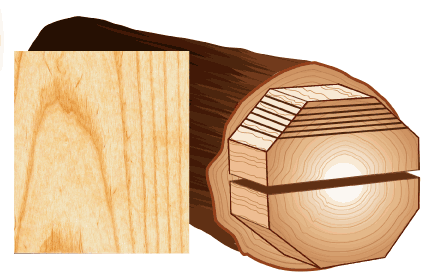
Rather than rotating the log, sliced veneer is produced by moving a flitch (log section) past a stationary blade. The orientation of the flitch relative to the blade determines whether the result is plain sliced or quarter sliced — two fundamentally different aesthetic outcomes from the same technique.
Plain Sliced (Flat Sliced) Veneer
The log is halved and mounted heart-side against the slicer. Cuts run parallel to the center of the log, progressively revealing the growth ring structure from the outside in.
PLAIN SLICED — cathedral / flame grain
Grain pattern
Classic "cathedral" or "flame" arches — a traditional decorative look
Yield
Highest of any slicing method
Best for
Doors, wall panels, furniture where classic grain is desired
High yieldVersatileTraditional aesthetic
Quarter Sliced Veneer
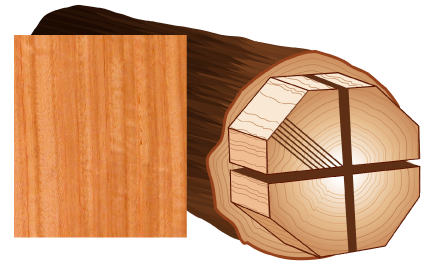
A quarter-log section is mounted so that the growth rings run perpendicular to the blade. Each cut crosses the rings at roughly 90°, producing a consistent straight grain with a characteristic ribbon or stripe effect. In oak, this orientation also reveals the medullary rays as a distinctive "flake" figure.
QUARTER SLICED — straight ribbon grain + flake
Grain pattern
Straight, linear ribbon — with medullary flake in oak and similar species
Yield
Lower than plain sliced — more log waste per sheet
Best for
High-end cabinetry, furniture, architectural panels requiring uniform grain
Medium yieldElegant linear lookPremium pricing
03
Lowest yield · Highest precision
A quarter-log is sliced at approximately 15° off-perpendicular to the growth rings — a slight but deliberate angular offset. This technique is primarily applied to oak, where it produces a clean, straight grain while minimizing the medullary ray fleck that appears in quarter-sliced oak.
RIFT CUT — straight grain, minimal ray fleck
Grain pattern
Clean, straight grain — minimal ray fleck and high visual consistency
Species
Primarily oak — the species where flake suppression matters most
Yield
Lowest of all methods — most veneer lost per log
Best for
Premium modern furniture, sleek contemporary interiors, flake-free oak specification
Lowest yieldHighest costMaximum grain consistencyModern design staple
Side-by-side
All four methods at a glance● High ◐ Medium ○ Low
Cut method | Grain pattern | Yield | Cost | Typical use |
|---|---|---|---|---|
Rotary | Bold, random, wide cathedral | ● | ● | Plywood cores, utility panels |
Plain sliced | Cathedral / flame arches | ● | ◐ | Doors, wall panels, classic furniture |
Quarter sliced | Straight ribbon + ray flake | ◐ | ◐ | High-end cabinetry, architectural panels |
Rift cut | Pure straight — no flake | ○ | ○ | Premium modern oak furniture & interiors |
Decision guide
You need maximum sheet width, the highest yield from your log budget, and grain uniformity is not a priority — plywood cores, backing sheets, budget furniture panels.
Your project calls for a traditional, warm, decorative grain. Cathedral figure works well on doors, wall paneling, and furniture with a classic or transitional aesthetic.
You want a clean, linear grain with consistent figure across matched panels. The right choice for high-end cabinetry, contemporary architectural work, and species that show attractive ray flake.
Your design demands the most controlled, straight-line grain possible — especially in oak — with minimal ray fleck. The premium option for sleek modern furniture and minimalist interiors.
FAQ
Both quarter sliced and rift cut veneer produce a straight, linear grain — but the angle of the cut differs. Quarter sliced cuts perpendicular to the growth rings (90°), which in oak also reveals the medullary rays as a decorative "flake" pattern. Rift cut uses a slight offset angle (approximately 75°, or 15° from perpendicular) that suppresses the ray flake, producing a cleaner, more uniform straight grain. Rift cut yields less veneer and is therefore more expensive.
Rotary cutting peels the veneer tangentially around the log's circumference, cutting across all growth ring layers at an angle. This produces a wide, bold, irregular grain with pronounced figure variation across the sheet. Sliced veneer cuts straight through the log in one direction, exposing the growth rings more consistently and producing a more predictable, repeatable grain pattern.
Not inherently — the choice is application-driven, not a quality hierarchy. Rotary cut veneer is structurally sound and is the standard for plywood face sheets worldwide. It is also the preferred choice for any project requiring wide, single-piece veneer faces. Sliced veneers are specified when a particular grain character is part of the design intent, such as the cathedral figure in plain sliced or the linear ribbon of quarter sliced.
Quarter sliced and plain sliced veneers are best suited for book-matching and slip-matching applications because consecutive slices from the same flitch are nearly identical, allowing symmetrical patterns to be created across joined panels. Rotary cut grain varies too randomly for controlled matching. Rift cut can be matched but its primary value is single-face consistency rather than decorative matching.
Yes, significantly. Rotary cut is the least expensive because it maximizes yield per log. Plain sliced is moderately priced and offers the highest yield of the slicing methods. Quarter sliced costs more due to lower yield and additional setup. Rift cut is the most expensive — it produces the least veneer per log and is a more labor-intensive process, with the added cost reflected in the finished price per square meter.
Rotary · Plain sliced · Quarter sliced · Rift
W
Wood veneer guide · Cutting techniques
The cutting method strongly influences grain pattern, visual character, material yield, and cost. This guide explains all primary veneer cutting techniques so you can specify the right cut for every project.
Rotary cutPlain slicedQuarter slicedRift cutGrain patterns
In this guide
The same species of wood, sliced four different ways, produces four completely different visual results. Understanding the cutting method is not a technical footnote — it is the first decision in veneer specification.
01
Most economical · Highest yield
A whole log is centered on a large lathe and rotated against a stationary blade. As the log turns, a continuous sheet of veneer peels away — the same principle as unrolling a paper towel. The result is the widest possible sheet from any given log.
ROTARY CUT — broad undulating grain
Grain pattern
Broad, bold, random — wide cathedral sweeps across the full sheet
Sheet width
Widest of all methods — can produce full single-piece faces
Cost
Most economical — maximum veneer yield per log
Best for
Plywood cores, utility panels, cost-sensitive large-format projects
High yieldLowest costNon-uniform grain
02
Sliced cutting · Two main variants
Rather than rotating the log, sliced veneer is produced by moving a flitch (log section) past a stationary blade. The orientation of the flitch relative to the blade determines whether the result is plain sliced or quarter sliced — two fundamentally different aesthetic outcomes from the same technique.
Plain Sliced (Flat Sliced) Veneer
The log is halved and mounted heart-side against the slicer. Cuts run parallel to the center of the log, progressively revealing the growth ring structure from the outside in.
PLAIN SLICED — cathedral / flame grain
Grain pattern
Classic "cathedral" or "flame" arches — a traditional decorative look
Yield
Highest of any slicing method
Best for
Doors, wall panels, furniture where classic grain is desired
High yieldVersatileTraditional aesthetic
Quarter Sliced Veneer
A quarter-log section is mounted so that the growth rings run perpendicular to the blade. Each cut crosses the rings at roughly 90°, producing a consistent straight grain with a characteristic ribbon or stripe effect. In oak, this orientation also reveals the medullary rays as a distinctive "flake" figure.
QUARTER SLICED — straight ribbon grain + flake
Grain pattern
Straight, linear ribbon — with medullary flake in oak and similar species
Yield
Lower than plain sliced — more log waste per sheet
Best for
High-end cabinetry, furniture, architectural panels requiring uniform grain
Medium yieldElegant linear lookPremium pricing
03
Lowest yield · Highest precision
A quarter-log is sliced at approximately 15° off-perpendicular to the growth rings — a slight but deliberate angular offset. This technique is primarily applied to oak, where it produces a clean, straight grain while minimizing the medullary ray fleck that appears in quarter-sliced oak.
RIFT CUT — straight grain, minimal ray fleck
Grain pattern
Clean, straight grain — minimal ray fleck and high visual consistency
Species
Primarily oak — the species where flake suppression matters most
Yield
Lowest of all methods — most veneer lost per log
Best for
Premium modern furniture, sleek contemporary interiors, flake-free oak specification
Lowest yieldHighest costMaximum grain consistencyModern design staple
Side-by-side
All four methods at a glance● High ◐ Medium ○ Low
Cut method | Grain pattern | Yield | Cost | Typical use |
|---|---|---|---|---|
Rotary | Bold, random, wide cathedral | ● | ● | Plywood cores, utility panels |
Plain sliced | Cathedral / flame arches | ● | ◐ | Doors, wall panels, classic furniture |
Quarter sliced | Straight ribbon + ray flake | ◐ | ◐ | High-end cabinetry, architectural panels |
Rift cut | Pure straight — no flake | ○ | ○ | Premium modern oak furniture & interiors |
Decision guide
You need maximum sheet width, the highest yield from your log budget, and grain uniformity is not a priority — plywood cores, backing sheets, budget furniture panels.
Your project calls for a traditional, warm, decorative grain. Cathedral figure works well on doors, wall paneling, and furniture with a classic or transitional aesthetic.
You want a clean, linear grain with consistent figure across matched panels. The right choice for high-end cabinetry, contemporary architectural work, and species that show attractive ray flake.
Your design demands the most controlled, straight-line grain possible — especially in oak — with minimal ray fleck. The premium option for sleek modern furniture and minimalist interiors.
FAQ
Both quarter sliced and rift cut veneer produce a straight, linear grain — but the angle of the cut differs. Quarter sliced cuts perpendicular to the growth rings (90°), which in oak also reveals the medullary rays as a decorative "flake" pattern. Rift cut uses a slight offset angle (approximately 75°, or 15° from perpendicular) that suppresses the ray flake, producing a cleaner, more uniform straight grain. Rift cut yields less veneer and is therefore more expensive.
Rotary cutting peels the veneer tangentially around the log's circumference, cutting across all growth ring layers at an angle. This produces a wide, bold, irregular grain with pronounced figure variation across the sheet. Sliced veneer cuts straight through the log in one direction, exposing the growth rings more consistently and producing a more predictable, repeatable grain pattern.
Not inherently — the choice is application-driven, not a quality hierarchy. Rotary cut veneer is structurally sound and is the standard for plywood face sheets worldwide. It is also the preferred choice for any project requiring wide, single-piece veneer faces. Sliced veneers are specified when a particular grain character is part of the design intent, such as the cathedral figure in plain sliced or the linear ribbon of quarter sliced.
Quarter sliced and plain sliced veneers are best suited for book-matching and slip-matching applications because consecutive slices from the same flitch are nearly identical, allowing symmetrical patterns to be created across joined panels. Rotary cut grain varies too randomly for controlled matching. Rift cut can be matched but its primary value is single-face consistency rather than decorative matching.
Yes, significantly. Rotary cut is the least expensive because it maximizes yield per log. Plain sliced is moderately priced and offers the highest yield of the slicing methods. Quarter sliced costs more due to lower yield and additional setup. Rift cut is the most expensive — it produces the least veneer per log and is a more labor-intensive process, with the added cost reflected in the finished price per square meter.
Rotary · Plain sliced · Quarter sliced · Rift
We supply all primary cut types in multiple species, thicknesses, and grades for furniture, plywood, and architectural applications.
Draft a veneer inquiry ↗
Wood veneer guide · Cutting techniques
The cutting method strongly influences grain pattern, visual character, material yield, and cost. This guide explains all primary veneer cutting techniques so you can specify the right cut for every project.
Rotary cutPlain slicedQuarter slicedRift cutGrain patterns
In this guide
The same species of wood, sliced four different ways, produces four completely different visual results. Understanding the cutting method is not a technical footnote — it is the first decision in veneer specification.
01
Most economical · Highest yield
A whole log is centered on a large lathe and rotated against a stationary blade. As the log turns, a continuous sheet of veneer peels away — the same principle as unrolling a paper towel. The result is the widest possible sheet from any given log.
ROTARY CUT — broad undulating grain
Grain pattern
Broad, bold, random — wide cathedral sweeps across the full sheet
Sheet width
Widest of all methods — can produce full single-piece faces
Cost
Most economical — maximum veneer yield per log
Best for
Plywood cores, utility panels, cost-sensitive large-format projects
High yieldLowest costNon-uniform grain
02
Sliced cutting · Two main variants
Rather than rotating the log, sliced veneer is produced by moving a flitch (log section) past a stationary blade. The orientation of the flitch relative to the blade determines whether the result is plain sliced or quarter sliced — two fundamentally different aesthetic outcomes from the same technique.
Plain Sliced (Flat Sliced) Veneer
The log is halved and mounted heart-side against the slicer. Cuts run parallel to the center of the log, progressively revealing the growth ring structure from the outside in.
PLAIN SLICED — cathedral / flame grain
Grain pattern
Classic "cathedral" or "flame" arches — a traditional decorative look
Yield
Highest of any slicing method
Best for
Doors, wall panels, furniture where classic grain is desired
High yieldVersatileTraditional aesthetic
Quarter Sliced Veneer
A quarter-log section is mounted so that the growth rings run perpendicular to the blade. Each cut crosses the rings at roughly 90°, producing a consistent straight grain with a characteristic ribbon or stripe effect. In oak, this orientation also reveals the medullary rays as a distinctive "flake" figure.
QUARTER SLICED — straight ribbon grain + flake
Grain pattern
Straight, linear ribbon — with medullary flake in oak and similar species
Yield
Lower than plain sliced — more log waste per sheet
Best for
High-end cabinetry, furniture, architectural panels requiring uniform grain
Medium yieldElegant linear lookPremium pricing
03
Lowest yield · Highest precision
A quarter-log is sliced at approximately 15° off-perpendicular to the growth rings — a slight but deliberate angular offset. This technique is primarily applied to oak, where it produces a clean, straight grain while minimizing the medullary ray fleck that appears in quarter-sliced oak.
RIFT CUT — straight grain, minimal ray fleck
Grain pattern
Clean, straight grain — minimal ray fleck and high visual consistency
Species
Primarily oak — the species where flake suppression matters most
Yield
Lowest of all methods — most veneer lost per log
Best for
Premium modern furniture, sleek contemporary interiors, flake-free oak specification
Lowest yieldHighest costMaximum grain consistencyModern design staple
Side-by-side
All four methods at a glance● High ◐ Medium ○ Low
Cut method | Grain pattern | Yield | Cost | Typical use |
|---|---|---|---|---|
Rotary | Bold, random, wide cathedral | ● | ● | Plywood cores, utility panels |
Plain sliced | Cathedral / flame arches | ● | ◐ | Doors, wall panels, classic furniture |
Quarter sliced | Straight ribbon + ray flake | ◐ | ◐ | High-end cabinetry, architectural panels |
Rift cut | Pure straight — no flake | ○ | ○ | Premium modern oak furniture & interiors |
Decision guide
You need maximum sheet width, the highest yield from your log budget, and grain uniformity is not a priority — plywood cores, backing sheets, budget furniture panels.
Your project calls for a traditional, warm, decorative grain. Cathedral figure works well on doors, wall paneling, and furniture with a classic or transitional aesthetic.
You want a clean, linear grain with consistent figure across matched panels. The right choice for high-end cabinetry, contemporary architectural work, and species that show attractive ray flake.
Your design demands the most controlled, straight-line grain possible — especially in oak — with minimal ray fleck. The premium option for sleek modern furniture and minimalist interiors.
FAQ
Both quarter sliced and rift cut veneer produce a straight, linear grain — but the angle of the cut differs. Quarter sliced cuts perpendicular to the growth rings (90°), which in oak also reveals the medullary rays as a decorative "flake" pattern. Rift cut uses a slight offset angle (approximately 75°, or 15° from perpendicular) that suppresses the ray flake, producing a cleaner, more uniform straight grain. Rift cut yields less veneer and is therefore more expensive.
Rotary cutting peels the veneer tangentially around the log's circumference, cutting across all growth ring layers at an angle. This produces a wide, bold, irregular grain with pronounced figure variation across the sheet. Sliced veneer cuts straight through the log in one direction, exposing the growth rings more consistently and producing a more predictable, repeatable grain pattern.
Not inherently — the choice is application-driven, not a quality hierarchy. Rotary cut veneer is structurally sound and is the standard for plywood face sheets worldwide. It is also the preferred choice for any project requiring wide, single-piece veneer faces. Sliced veneers are specified when a particular grain character is part of the design intent, such as the cathedral figure in plain sliced or the linear ribbon of quarter sliced.
Quarter sliced and plain sliced veneers are best suited for book-matching and slip-matching applications because consecutive slices from the same flitch are nearly identical, allowing symmetrical patterns to be created across joined panels. Rotary cut grain varies too randomly for controlled matching. Rift cut can be matched but its primary value is single-face consistency rather than decorative matching.
Yes, significantly. Rotary cut is the least expensive because it maximizes yield per log. Plain sliced is moderately priced and offers the highest yield of the slicing methods. Quarter sliced costs more due to lower yield and additional setup. Rift cut is the most expensive — it produces the least veneer per log and is a more labor-intensive process, with the added cost reflected in the finished price per square meter.
Rotary · Plain sliced · Quarter sliced · Rift
We supply all primary cut types in multiple species, thicknesses, and grades for furniture, plywood, and architectural applications.
Draft a veneer inquiry ↗
Wood veneer guide · Cutting techniques
The cutting method determines everything: grain pattern, visual character, cost, and yield. This guide explains all primary veneer cutting techniques so you can specify the right cut for every project.
The same species of wood, sliced four different ways, produces four completely different visual results. Understanding the cutting method is not a technical footnote — it is the first decision in veneer specification.
Most economical · Highest yield
A whole log is centered on a large lathe and rotated against a stationary blade. As the log turns, a continuous sheet of veneer peels away — the same principle as unrolling a paper towel. The result is the widest possible sheet from any given log.
Grain pattern
Broad, bold, random — wide cathedral sweeps across the full sheet
Sheet width
Widest of all methods — can produce full single-piece faces
Cost
Most economical — maximum veneer yield per log
Best for
Plywood cores, utility panels, cost-sensitive large-format projects
Sliced cutting · Two main variants
Rather than rotating the log, sliced veneer is produced by moving a flitch (log section) past a stationary blade. The orientation of the flitch relative to the blade determines whether the result is plain sliced or quarter sliced — two fundamentally different aesthetic outcomes from the same technique.
Plain Sliced (Flat Sliced) Veneer
The log is halved and mounted heart-side against the slicer. Cuts run parallel to the center of the log, progressively revealing the growth ring structure from the outside in.
Grain pattern
Classic "cathedral" or "flame" arches — a traditional decorative look
Yield
Highest of any slicing method
Best for
Doors, wall panels, furniture where classic grain is desired
Quarter Sliced Veneer
A quarter-log section is mounted so that the growth rings run perpendicular to the blade. Each cut crosses the rings at roughly 90°, producing a consistent straight grain with a characteristic ribbon or stripe effect. In oak, this orientation also reveals the medullary rays as a distinctive "flake" figure.
Grain pattern
Straight, linear ribbon — with medullary flake in oak and similar species
Yield
Lower than plain sliced — more log waste per sheet
Best for
High-end cabinetry, furniture, architectural panels requiring uniform grain
Lowest yield · Highest precision
A quarter-log is sliced at approximately 15° off-perpendicular to the growth rings — a slight but deliberate angular offset. This technique is primarily applied to oak, where it produces a clean, perfectly straight grain while eliminating the medullary ray flake that appears in quarter-sliced oak.
Grain pattern
Pure, clean straight line — no flake, no figure, maximum consistency
Species
Primarily oak — the species where flake suppression matters most
Yield
Lowest of all methods — most veneer lost per log
Best for
Premium modern furniture, sleek contemporary interiors, flake-free oak specification
Side-by-side
Decision guide
You need maximum sheet width, the highest yield from your log budget, and grain uniformity is not a priority — plywood cores, backing sheets, budget furniture panels.
Your project calls for a traditional, warm, decorative grain. Cathedral figure works well on doors, wall paneling, and furniture with a classic or transitional aesthetic.
You want a clean, linear grain with consistent figure across matched panels. The right choice for high-end cabinetry, contemporary architectural work, and species that show attractive ray flake.
Your design demands the most controlled, straight-line grain possible — especially in oak — with no flake pattern. The premium option for sleek modern furniture and minimalist interiors.
FAQ
Both quarter sliced and rift cut veneer produce a straight, linear grain — but the angle of the cut differs. Quarter sliced cuts perpendicular to the growth rings (90°), which in oak also reveals the medullary rays as a decorative "flake" pattern. Rift cut uses a slight offset angle (approximately 75°, or 15° from perpendicular) that suppresses the ray flake, producing a cleaner, more uniform straight grain. Rift cut yields less veneer and is therefore more expensive.
Rotary cutting peels the veneer tangentially around the log's circumference, cutting across all growth ring layers at an angle. This produces a wide, bold, irregular grain with pronounced figure variation across the sheet. Sliced veneer cuts straight through the log in one direction, exposing the growth rings more consistently and producing a more predictable, repeatable grain pattern.
Not inherently — the choice is application-driven, not a quality hierarchy. Rotary cut veneer is structurally sound and is the standard for plywood face sheets worldwide. It is also the preferred choice for any project requiring wide, single-piece veneer faces. Sliced veneers are specified when a particular grain character is part of the design intent, such as the cathedral figure in plain sliced or the linear ribbon of quarter sliced.
Quarter sliced and plain sliced veneers are best suited for book-matching and slip-matching applications because consecutive slices from the same flitch are nearly identical, allowing symmetrical patterns to be created across joined panels. Rotary cut grain varies too randomly for controlled matching. Rift cut can be matched but its primary value is single-face consistency rather than decorative matching.
Yes, significantly. Rotary cut is the least expensive because it maximizes yield per log. Plain sliced is moderately priced and offers the highest yield of the slicing methods. Quarter sliced costs more due to lower yield and additional setup. Rift cut is the most expensive — it produces the least veneer per log and is a more labor-intensive process, with the added cost reflected in the finished price per square meter.