meta name="google-site-verification" content="XXXXXXXXXXX " /
PRODUCTS
You are here: Home » Products » Abrasive » Hook and Loop Sanding Discs: Abrasive Materials, Grit Selection, and Usage Guide

Hook and Loop Sanding Discs: Abrasive Materials, Grit Selection, and Usage Guide

Hook and loop sanding discs are circular abrasive sheets bonded to a backing that uses interlocking hook and loop fasteners — the same mechanism as Velcro. They press firmly onto a compatible sander pad and release cleanly without tools, adhesives, or clamps, allowing rapid disc changes between grits. They are compatible with orbital sanders, random orbital sanders, and disc sanders used in woodworking, metalworking, automotive finishing, and construction.
Availability:
Quantity:
sharethis sharing button
  • 2inch-9inch

  • 沂禾

  • 6805200000

Abrasive tools guide · Power sanding · Hook and loop system

Hook and Loop Sanding Discs: Abrasive Materials, Grit Selection, and Usage Guide

Hook and loop sanding discs are circular abrasive sheets with a Velcro-style backing for tool-free attachment to orbital, random orbital, and disc sanders. This guide covers abrasive materials, grit sizes, compatible applications, step-by-step usage, and selection criteria for wood, metal, and plastic surfaces.

Aluminum oxide · Silicon carbide · Zirconia alumina Grits 60# – 220# Wood · Metal · Plastic · Ceramic Orbital · Random orbital · Disc sanders
Backing system
Hook & loop
Tool-free change
Abrasive types
3 materials
AO · SiC · Zirconia
Grit range
60# – 220#
Coarse to fine
Compatible materials
Wood, metal
Plastic, ceramic, stone
Self-sharpening
AO & Zirconia
Extended disc lifespan

202206281620356c900b33f89a4b4a8df0df2bad494c88

Hook and loop sanding discs are circular abrasive sheets bonded to a backing that uses interlocking hook and loop fasteners — the same mechanism as Velcro. They press firmly onto a compatible sander pad and release cleanly without tools, adhesives, or clamps, allowing rapid disc changes between grits. They are compatible with orbital sanders, random orbital sanders, and disc sanders used in woodworking, metalworking, automotive finishing, and construction.


21dff40f01e5464056b17f8e7ab775

Aluminum oxide
Aluminum oxide (AO)
The most common and versatile abrasive. Self-fractures during use to expose fresh cutting edges, maintaining sharpness and extending disc life. Suitable for the widest range of materials and grit sizes.
Wood · Metal · Plastic
Silicon carbide
Silicon carbide (SiC)
Harder and sharper than aluminum oxide. Produces a very fine finish on brittle or hard non-metallic surfaces. Less suited for wood due to faster wear on softer fibrous material.
Glass · Ceramic · Stone
Zirconia alumina
Zirconia alumina
A heavy-duty premium abrasive for aggressive stock removal on hard metals. Self-sharpens under pressure and significantly outlasts standard abrasives in high-load applications.
Stainless steel · Titanium · Aluminum


b89d3332ea4c1fa3b45a4cb6f982d3_1006_1006

Grit number = abrasive particle density per inch. Lower numbers cut faster and remove more material. Higher numbers produce a finer surface finish with shallower scratch depth.

Grit Grade Coarseness Best use
60# Coarse
Rapid material removal, shaping rough surfaces, stripping paint or old finish, preparing the workpiece for finer grits.
100# Medium
General sanding and scratch removal after coarse passes. Levels surface irregularities and creates a smooth base for fine finishing.
220# Fine
Final surface preparation before painting, staining, or lacquering. Removes medium-grit marks and produces a paint-ready surface.

Sandpapaer-Disc


1
Select the correct disc
Match the abrasive to the workpiece material — aluminum oxide for wood, metal, or plastic; silicon carbide for glass, ceramic, or stone; zirconia alumina for hard metals needing aggressive removal. Choose grit based on task: 60# to shape or strip, 100# for general smoothing, 220# before applying any finish.
2
Attach the disc securely
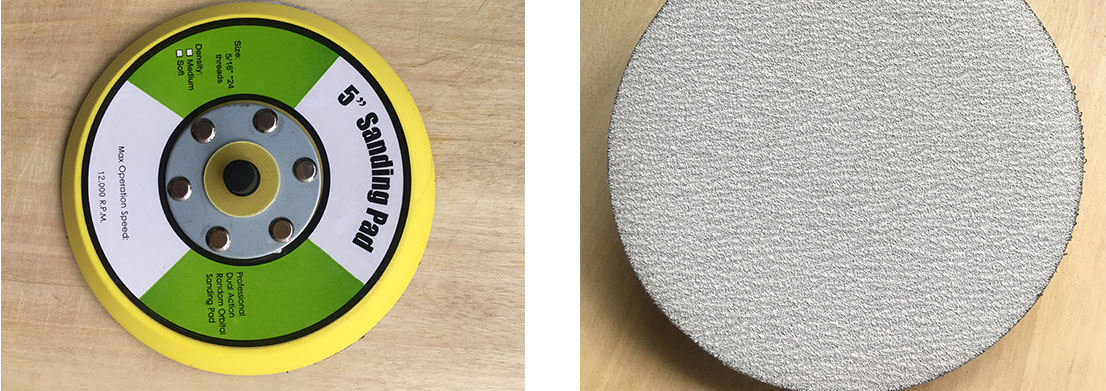
Centre the disc on the sander's hook pad and press firmly across the full surface. Eliminate any gaps, bubbles, or wrinkles at the edges — uneven contact causes uneven sanding and premature disc wear.
3
Sand with consistent, even pressure
Start the sander before making contact with the workpiece. Move in smooth, overlapping passes with light to moderate downward pressure. Avoid dwelling in one spot — this creates heat buildup that clogs abrasive and removes material unevenly.
4
Replace the disc when worn
Stop the sander fully before removing the disc. Replace when the disc glazes (shiny surface), clogs with dust or resin, cuts noticeably slower, or shows visible abrasive loss. A worn disc wastes time and degrades finish quality.
⚠️
Safety: Always wear eye protection and a dust mask or respirator. Fine particles from wood, metal, and silica-bearing materials (ceramic, stone) are respiratory and eye hazards. Ensure adequate ventilation, especially in enclosed workspaces.
Orbital sander
Random orbital sander
Disc sander
Hand sanding block
Angle grinder (with pad)
Abrasive for wood Aluminum oxide, 60#–220# depending on stage
Abrasive for metal Aluminum oxide (general) / Zirconia alumina (hard metals, heavy removal)
Abrasive for glass / ceramic / stone Silicon carbide, fine grits
Starting grit (rough surface) 60# coarse — shaping and stock removal
Intermediate grit 100# medium — general smoothing
Finishing grit 220# fine — pre-paint or pre-stain surface prep
Replace disc when Glazed, clogged, reduced cutting speed, abrasive visibly worn
Required PPE Eye protection, dust mask or respirator
What is a hook and loop sanding disc?
A hook and loop sanding disc is a circular abrasive sheet with a Velcro-style backing that attaches to a compatible sander pad by pressing on and releases by peeling off — no tools or adhesive required. They are used with orbital sanders, random orbital sanders, and disc sanders for sanding wood, metal, plastic, ceramic, and other surfaces.
What is the difference between aluminum oxide, silicon carbide, and zirconia alumina sanding discs?
Aluminum oxide is the most versatile abrasive — suited for wood, metal, and plastic — and self-fractures to stay sharp throughout its life. Silicon carbide is harder and produces a finer finish, best for glass, ceramic, and stone. Zirconia alumina is a premium heavy-duty abrasive for aggressive removal on hard metals like stainless steel, titanium, and aluminum; it cuts faster and lasts longer than standard abrasives under high-load conditions.
What grit sanding disc should I use?
Use 60# (coarse) for rapid stock removal, shaping rough surfaces, and stripping old finishes. Use 100# (medium) for general sanding and removing marks from coarser passes. Use 220# (fine) for final surface preparation before painting, staining, or applying a clear coat. Work progressively through grits for the best finish quality.
How do I attach and remove a hook and loop sanding disc?
Align the disc over the sander's hook pad and press firmly across the full surface until flat with no gaps or wrinkles. To remove, peel the disc from one edge. No tools are required. Always stop the sander completely before changing discs.
When should I replace a sanding disc?
Replace a sanding disc when it glazes (the surface turns shiny and smooth), becomes clogged with dust or resin, cuts noticeably slower than when new, or shows visible abrasive loss. Using a worn disc wastes time and produces poor surface quality.
What safety precautions are required when using sanding discs?
Always wear eye protection against abrasive debris and a dust mask or respirator — fine wood dust, metal particles, and silica-bearing dust from stone or ceramic are respiratory hazards. Ensure adequate ventilation in enclosed workspaces, especially when sanding materials that produce hazardous fine dust.
Are hook and loop discs compatible with all sanders?
Hook and loop discs require a sander fitted with a matching hook pad. They are compatible with most orbital, random orbital, and disc sanders that use this backing system. Confirm the disc diameter matches your sander model before purchasing. They are not compatible with belt sanders or sheet sanders that use clamp or clip fastening systems.
Hook and loop sanding discs provide fast, tool-free attachment to orbital and random orbital sanders and cover the full range of sanding tasks from aggressive stock removal to fine pre-finish preparation. The three core abrasive types — aluminum oxide for general use, silicon carbide for hard non-metallic surfaces, and zirconia alumina for heavy-duty metalwork — combined with a grit progression from 60# coarse through 220# fine, make them the most practical and versatile abrasive disc format for both professional and workshop sanding applications.
Previous: 
Next: 
YUPING MERCHANDISE
Linyi Yuping Merchandise Co., Ltd. is an intergrated company of industry and trade.
QUICK LINKS
PRODUCT CATEGORIES
CONTCAT US
   linyiyuping@hotmail.com
  +86-15605390885
 1206-069,NO.100 LINGONG ROAD, LINYI CITY, SHANDONG, CHINA
Copyright © 2021 Linyi Yuping Merchandise Co., Ltd.   Technology by leadong